Writings · Aufbau · 1944 – 1949
Writings.
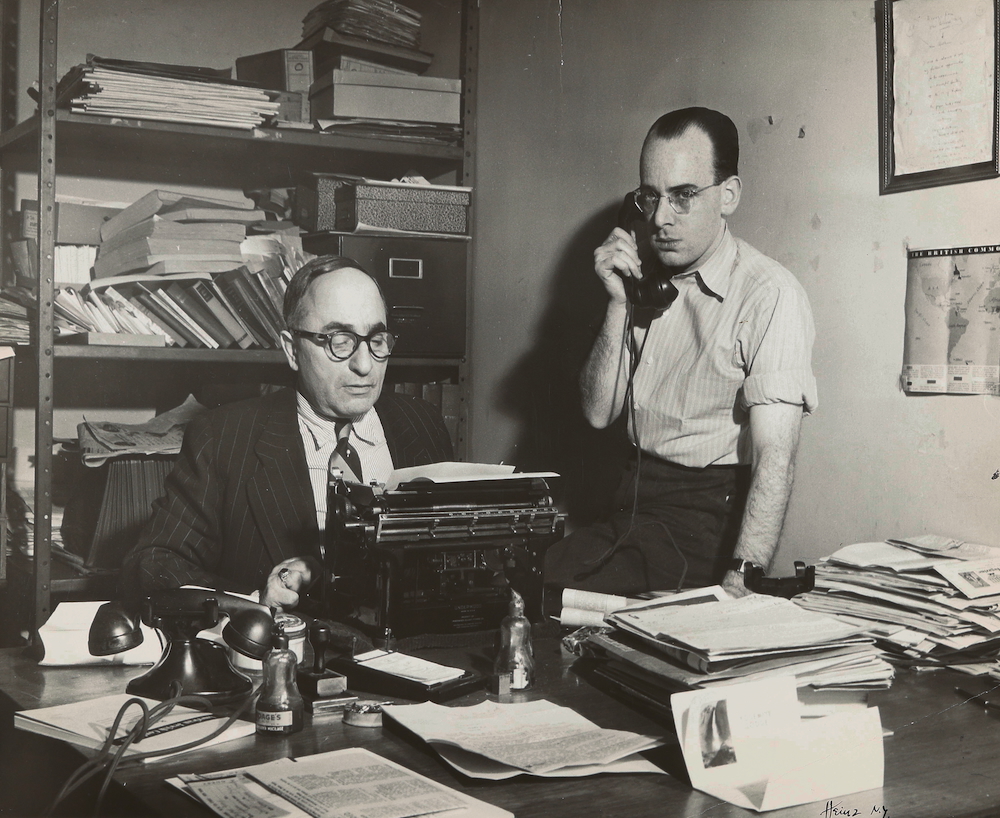
From 1939 to 1952 Kurt Hellmer edited — and often ran — the German-Jewish exile weekly Aufbau in New York, where he wrote the columns Anti-Anti, New Yorker Notizbuch, and Broadway Bulletin. A selection of his pieces, transcribed in the original German with English translations.

Aufbau
7 July 1944Wenn Johnny einmal fragen wird…
When Johnny One Day Asks…
Read →
Aufbau
March 1945Was wird aus Oesterreich?
What Will Become of Austria?
Written on the seventh anniversary of the Anschluss, Hellmer surveys the Allied plan to occupy Austria in three zones, weighs the still-fragile Austrian resistance against the Moscow Declaration's demand for a national contribution to liberation, and reports proposals from Ferdinand Czernin (Austrian Action) and Minister Hans Rott (Free Austrian Movement) for stripping the 850,000 Austrian NSDAP members of citizenship and rebuilding the country as a democratic, economically viable state within a new Europe.
Read →
Aufbau · Anti-Anti
Friday, 18 March 1949„Wer Deutschland hilft, hilft Amerika“
"He Who Helps Germany, Helps America"
First exposé published in any paper of Americans who are engaged in a campaign to whitewash Nazi Germany.
Read →
Aufbau · Anti-Anti
Friday, 27 May 1949Dolchstoss gegen IsraelEine gefährliche Bewegung
Daggers Against Israel — A dangerous movement
First exposé published in any paper of the anti-Zionist and anti-Israel activities of some Jews and Non-Jews.
Read →
Aufbau · Anti-Anti
Friday, 5 August 1949Die Antisemiten reorganisieren sich
The Anti-Semites Reorganize
First exposé published in any paper of a new nation-wide organization of anti-Semites.
Read →
Aufbau
22 December 1944Berlin und Wien am Broadway
Berlin and Vienna on Broadway
A ten-year retrospective (1934–1944) surveying the participation of German- and Austrian-speaking authors, composers, actors, conductors, stage designers and producers in roughly 150 Broadway productions. Hellmer catalogues the plays adapted from the former Central European repertoire, the operettas that outperformed the straight plays, the special productions (Die Pfeffermühle, Shakespeare's Merchant 1939, the From Vienna and Reunion in New York revues), the actors who reached prominent positions — from Mady Christians, Joseph Schildkraut and Walter Slezak to the wave that arrived after 1933 (Bergner, Bois, Lenya, Lederer, Homolka, Karlweis, Ernst Deutsch and many more) — the conductors (Robert Stolz, Maurice Abravanel, Erich Wolfgang Korngold, Fritz Mahler), stage designers (Ernst Stern, Harry Horner, H. A. Condell, Wolfgang Roth, costumes by Ladislas Czettel) and producers (Piscator, Armin Robinson, Otto Preminger, Hans Bartsch, Paul Czinner), and closes with a reflection on how the "von drüben" theatre people assimilated to the Broadway machine.
Read →